

Short CommentaryOpen Access, Volume 3 Issue 2
The psycho-neuro-endocrine-immune (PNEI) axis: Unravelling the intricate link between mind, motor neurons, master immune-endocrines, motility, microbiome and metabolic chaos
Ramnik Patel1*; Shailinder Jit Singh2
1Department of Paediatric Urology, University College London Hospitals NHS Foundation Trust, London, UK.
2Nottingham University Hospitals NHS Foundation Trust, Nottingham UK.
*Corresponding author: Ramnik Patel
Department of Paediatric Urology, University College London Hospitals NHS Foundation Trust, London, UK.
Email: ramnik@doctors.org.uk
Received : Nov 22, 2025 Accepted : Dec 15, 2025 Published : Dec 22, 2025
Epidemiology & Public Health - www.jpublichealth.org
Copyright: Patel R © All rights are reserved
Citation: Patel R, Singh SJ. The psycho-neuro-endocrine immune (PNEI) axis: Unravelling the intricate link between mind, motor neurons, master immune-endocrines, motility, microbiome and metabolic chaos. Epidemiol Public Health. 2025; 3(2): 1082.
Introduction
The global obesity epidemic, coupled with the alarming rise of insulin resistance and metabolic syndrome, poses a formida ble challenge to public health. Interaction between the gut and the brain is essential for energy homeostasis. In obesity, this ho meostasis is disrupted. While traditional views have focused on diet and exercise, a more nuanced understanding is emerging— one that connects our mental state, nervous system, hormonal balance, and immune function to the all-rounder par excellence gut secreto-motility aspects affecting trillions of microorgan isms in our gut. This intricate communication network is known as the Psycho-Neuro-Endocrine-Immune (PNEI) axis, and its dis ruption may be a key driver of the obesity crisis. The crucial role of the gut microbiota in the Gut–Brain Axis in obesity cannot be underestimated.
For too long, the mind and body have been treated as separate entities, a philosophical and medical duality that has hindered our understanding of complex illnesses. The PNEI framework shatters this outdated concept, providing a cohesive model that shows how psychological stress can initiate a cascade of biological changes that disrupt gut health and me tabolism.
The PNEI axis and the stress-induced cascade
Stress, both acute and chronic, is a central driver of this pro cess. The brain, perceiving a threat, activates the Hypothalam ic-Pituitary-Adrenal (HPA) axis, flooding the body with stress hormones like cortisol. This response, intended for short-term survival, has detrimental long-term effects when chronically triggered. Elevated cortisol levels have been shown to directly increase visceral fat accumulation and promote insulin resis tance.
Simultaneously, the PNEI axis orchestrates a shift in the im mune system, leading to a state of chronic, low-grade inflam mation. This inflammation is a key hallmark of obesity and met abolic syndrome. In adipose tissue, it impairs insulin signalling, creating a vicious cycle where inflammation exacerbates insulin resistance, and poor metabolic control further fuels inflamma tion.
The microbiome’s metabolic footprint
At the core of this complex system is the gut microbiome— a vast, dynamic ecosystem of bacteria and other microorgan isms. The PNEI axis directly influences this microbial community through mechanisms such as altered gut motility and stress-in duced changes in the gut environment. A high-fat, high-sugar diet can also directly and rapidly alter the gut’s microbial make up, leading to a state of dysbiosis.
A key consequence of this dysbiosis is increased intestinal permeability, or “leaky gut”. When the gut barrier is compro mised, bacterial components like Lipopolysaccharides (LPS) can leak into the bloodstream. This triggers an inflammatory re sponse throughout the body, a condition known as metabolic endotoxemia, which significantly contributes to insulin resis tance.
Furthermore, the gut microbiome modulates metabolism through its own communication channels. Microbes produce metabolites, most notably Short-Chain Fatty Acids (SCFAs) such as butyrate. These SCFAs are crucial for maintaining gut barrier integrity and promoting insulin sensitivity. Dysbiosis, particular ly a reduction in SCFA-producing bacteria, directly hinders these protective effects. The microbiome also influences host energy harvesting and central appetite signals, with certain microbial compositions being more efficient at extracting calories from food, contributing to weight gain.
A new path forward
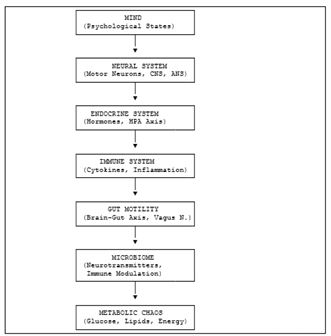
The intricate relationship between the PNEI axis, the gut microbiome, and metabolic health offers a compelling new perspective on the obesity epidemic. It suggests that simply addressing diet and exercise is insufficient without also con sidering the critical roles of psychological stress, inflammation, and gut health. This understanding paves the way for innova tive, multi-targeted therapies that aim to restore balance to the entire system as illustrated in figure 1.
PNEI Axis Model
Key
• Mind influences neural activity via stress, mood, and cognition.
• Neural system communicates with endocrine glands and immune cells.
• Endocrine system regulates hormones that affect immunity, motility, and metabolism.
• Immune system sends cytokine signals back to the brain and endocrine organs.
• Gut motility is regulated by neural, hormonal, and immune inputs.
• Microbiome modulates neurotransmitters, immune tone, and metabolic pathways.
• Metabolic chaos is the downstream effect of chronic dysregulation in the entire axis.
The mind as the first messenger
Psychological states—whether fleeting anxiety or chronic de pression—are not confined to the brain. Through the Hypotha lamic–Pituitary–Adrenal (HPA) axis, emotional stress can trigger hormonal surges, alter neurotransmitter balance, and prime immune cells for either hyperactivity or suppression. This is why prolonged psychological strain can manifest as muscle weak ness, inflammatory flare-ups, or even autoimmune disorders.
Motor neurons and the body’s wiring
Motor neurons, the final common pathway for voluntary movement, are exquisitely sensitive to the biochemical climate shaped by the PNEI axis. Chronic inflammation, oxidative stress, and hormonal imbalances can impair their function, contribut ing to conditions ranging from subtle coordination deficits to neurodegenerative diseases. The mind–motor connection is not just about motivation—it is about molecular cross-talk.
Master immune–endocrine interplay
The immune and endocrine systems are not separate armies; they are co-commanders. Cytokines—immune signalling mol ecules—can influence cortisol release, while hormones like oestrogen and testosterone modulate immune cell activity. This bidirectional relationship means that a viral infection can alter mood and cognition, just as a hormonal imbalance can predis pose someone to chronic inflammation.
Motility and the gut–brain–immune triangle
Gut motility is a surprisingly sensitive barometer of PNEI health. The brain–gut axis, mediated by the vagus nerve, neu rotransmitters, and immune signals, determines how efficiently the digestive tract moves. Stress-induced motility changes can lead to constipation, diarrhoea, or irritable bowel syndrome— conditions now understood to be as much neurological and im munological as they are gastrointestinal.
Microbiome: The fifth player
The trillions of microbes in our gut are not passive passen gers; they are active participants in the PNEI network. They produce neurotransmitters, modulate immune responses, and influence metabolic pathways. Dysbiosis—an imbalance in mi crobial populations—can amplify inflammation, disrupt hor monal rhythms, and even alter behaviour.
Metabolic chaos: The final common pathway
When the PNEI axis is chronically dysregulated, the result is metabolic chaos—a state where blood sugar control, lipid metabolism, and energy balance spiral out of order. This is not just a by-product of poor diet or sedentary lifestyle; it is the cu mulative effect of a stressed mind, inflamed neurons, misfiring hormones, and a disrupted microbiome.
The PNEI axis is not a theory—it is the living proof that “mental health” and “physical health” are inseparable.
Potential interventions could include:
• Stress management techniques: Practices such as mindfulness, meditation, and cognitive behavioural therapy can dampen HPA axis activity and reduce chronic inflammation.
• Dietary interventions: A diet rich in fibre and whole foods can promote a diverse and healthy gut microbiome, boosting the production of beneficial SCFAs.
• Probiotics and prebiotics: Supplementing with beneficial bacteria (probiotics) and the fibres that feed them (prebiotics) can help restore a healthy microbial balance.
• Fecal microbiota transplantation (FMT): For severe cases of dysbiosis, transferring a healthy donor’s gut microbiota has shown promise in improving insulin sensitivity.
• Targeting neuroendocrine pathways: Research into medications that modulate the PNEI axis and specific signalling molecules is ongoing.
The future of managing obesity and metabolic syndrome lies in an integrated approach. By embracing the PNEI paradigm, we can move beyond treating symptoms and begin to address the root causes of these complex, interconnected diseases. It is time for a medical and societal shift toward understanding the profound connection between our mind, our microbes, and our metabolic destiny.
Why this matters now
In an era where chronic diseases are the leading cause of death, the PNEI framework offers a unifying lens. It urges clini cians to treat depression and diabetes, Parkinson’s and IBS, not as isolated pathologies but as interconnected expressions of a single, complex system. It also challenges public health to ad dress stress, nutrition, and social determinants of health with equal urgency.
The takeaway: The PNEI axis is the body’s ultimate sys tems biology lesson. It tells us that healing the mind can heal the body, and vice versa—but only if we stop treating them as strangers.
Conclusion
The Psycho-Neuro-Endocrine-Immune (PNEI) Axis is now unravelling the Mind–Body Web in the age of metabolic chaos. In the age of precision medicine, we are finally beginning to dismantle the old silos that kept psychiatry, neurology, endocrinology, and immunology in separate rooms. The Psycho Neuro-Endocrine-Immune (PNEI) axis is not just a scientific curiosity—it is a paradigm shift. It tells us that the mind is not an ethereal passenger in the body, but an active conductor in a symphony of hormones, neurons, immune cells, and even microbes. And when this orchestra falls out of tune, the result is not just “stress” or “illness,” but a cascade of dysfunctions— affecting everything from motor neurons to gut motility, from immune resilience to metabolic stability.
Declarations
Contributions: Shailinder Jit Singh: Conceptualization, data curation, visualization, writing of the original draft, editing. Ramnik V Patel: Conceptualization, visualization, writing of the original draft, editing.
Conflict of interest: The authors declare no competing interests.
Publisher’s note: Springer Nature remains neutral with regard to jurisdictional claims in published maps and institutional affiliations
References
- O’Riordan KJ, Moloney GM, Keane L, Clarke G, Cryan JF. The gut microbiota-immune-brain axis: therapeutic implications. Cell Rep Med. 2025; 6: 101982.
- Stifani N. Motor neurons and the generation of spinal motor neuron diversity. Front Cell Neurosci. 2014; 8: 293.
- McCallum G, Tropini C. The gut microbiota and its biogeography. Nat Rev Microbiol. 2024; 22: 105–118.
- Macpherson AJ, Pachnis V, Prinz M. Boundaries and integration between microbiota, the nervous system, and immunity. Immunity. 2023; 56: 1712–1726.
- Ratsika A, Cruz Pereira JS, Lynch CMK, Clarke G, Cryan JF. Microbiota-immune-brain interactions: a lifespan perspective. Curr Opin Neurobiol. 2023; 78: 102652.
- Sharkey KA, Mawe GM. The enteric nervous system. Physiol Rev. 2023; 103: 1487–1564.
- Simpson JB, Walker ME, Sekela JJ, Ivey SM, Jariwala PB, Storch CM, et al. Gut microbial beta-glucuronidases influence endobiotic homeostasis and are modulated by diverse therapeutics. Cell Host Microbe. 2024; 32: 925–944.e10.
- Sanidad KZ, Rager SL, Carrow HC, Ananthanarayanan A, Callaghan R, Hart LR, et al. Gut bacteria-derived serotonin promotes immune tolerance in early life. Sci Immunol. 2024; 9: adj4775.
- Aburto MR, Cryan JF. Gastrointestinal and brain barriers: unlocking gates of communication across the microbiota-gut brain axis. Nat Rev Gastroenterol Hepatol. 2024; 21: 222–247.
- Dalile B, Fuchs A, La Torre D, Vervliet B, Van Oudenhove L, Verbeke K. Colonic butyrate administration modulates fear memory but not the acute stress response in men: a randomized, triple blind, placebo-controlled trial. Prog Neuropsychopharmacol Biol Psychiatry. 2024; 131: 110939.